The 1905 Almost Jackie: William Clarence Matthews
From Moses Fleetwood Walker in September of 1884 to Jackie Robinson in April of 1947, the major leagues had zero Black baseball players. But one man, almost broke through. He has an incredible story. Maybe you’ve heard of him, maybe you haven’t – but his life is fascinating!
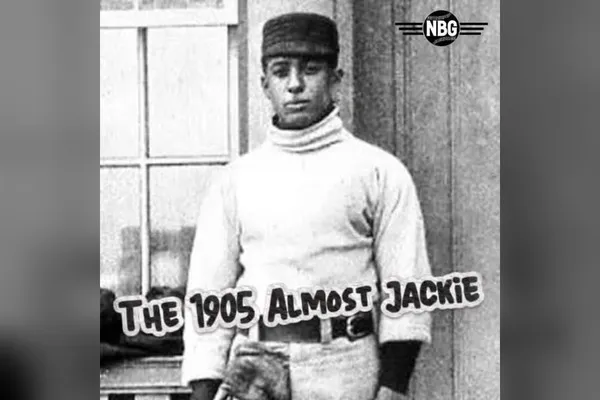
William Clarence Matthews in 1905.
To understand how this almost happened – you must understand how incredible of a player and person Matthews was. He was brilliant! As a young man, he was enrolled in the Tuskegee Institute and was a student of the legendary Booker T. Washington. He trained to become a tailor, wound up organizing a football team, and captained the baseball team. Matthews would graduate as the salutatorian of his class.
Washington helped Matthews gain acceptance into the prestigious Phillips Andover Academy. Matthews was the only Black student in a class of nearly 100. After impressing the faculty and students with his academic and athletic exploits, he was then – on the recommendation from the principal at Phillips Andover – admitted into Harvard!
Before the minor leagues existed, institutions like Harvard are one of the main places teams looked for talent. When Matthews started playing for the Harvard team, Cy Young was their pitching coach and Wee Willie Keeler their hitting instructor! Mathews place on the team wasn’t without controversy.
In his freshman year, he stayed back when the Harvard team ventured south to play at Virginia and Navy. In his sophomore year, Georgetown threatened to boycott a game against Harvard if the Crimson didn’t pull Matthews from the lineup. Though the Georgetown team ultimately relented, their captain refused to play in the game.
Despite some turmoil, Mathews excelled. He led the team in hitting his sophomore, junior, and senior seasons while provided excellent defense and speed on the bases. The Harvard team went 78-18 over that span. Mathews had a .400 average his senior season and stole 25 bases. The Boston Post said he was “the best infielder Harvard ever had,” the school’s “greatest big league prospect,” and “no doubt the greatest colored athlete of all time.”
After graduating, Mathews decided to keep playing ball! He signed a contract with a team in the Northern League from Burlington, Vermont. With Matthews’ arrival, the Northern League was integrated, becoming quite likely the only predominantly white professional league at that point in time that could make the claim. In Matthews first game he provided three hits and was “liberally applauded” by the home crowd according to the Burlington Free Press.
The national perspective was not as favorable to Matthews. The Sporting Life reported that the arrival of “the Negro shortstop from Harvard into the Vermont League threatens to disrupt that organization.” The Atlanta Journal said, “The debut of the human chocolate drop is about to break up this league.”
Mathews hit .314 in his first 13 games when the big news hit…the Boston Beaneaters (Braves eventually) had a manager by the name of Fred Tenney who was struggling with his team and needed a second baseman. Tenney was an Ivy League man himself, coming from Brown. And the rumor was that he was looking to sign Mathews!
“Matthews May Play Ball with Tenney’s Team,” was the headline of the Boston Traveler.
The rumor quickly dissipated with some claiming that the southern teams of the National League had threatened to leave and form a new league if Matthews played and others contending that National League President Harry Pulliam had intervened to prevent signing Matthews.
Mathews weighed in the matter himself and said the following:
“I think it is an outrage that colored men are discriminated against in the big leagues. What a shame it is that black men are barred forever from participating in the national game. I should think that Americans should rise up in revolt against such a condition. Many negroes are brilliant players and should not be shut out because their skin is black. As a Harvard man, I shall devote my life to bettering the condition of the black man, and especially to secure his admittance into organized baseball.”
Cubs president Jim Hart told the Chicago Daily News that “personally, I have no objections to a Negro playing baseball,” said Hart, “but I do not think it is right to inflict him on others who have objections or forcing white players to sleep in the same car with him and associate as intimately as they would have to under such conditions. That is the real objection to a Negro in baseball.”
Hart added that National League president Harry Pulliam’s “good Southern blood would never stand for it.”
Mathews played out the season, but his situation only got worse. He was spiked so often that he was moved from shortstop to the outfield to lessen his odds of injury. After his one season of semi-pro ball, Mathews weighed his options and decided to pursue another path. He enrolled in Boston University Law School, and he passed the bar in 1908.
In 1912, he was appointed by President William Howard Taft as special assistant to the U.S. district attorney in Boston. During the 1924 Presidential election, Matthews became an important supporter Calvin Coolidge. Matthews became the Head of the Colored Division of the Republican National Committee. After Coolidge’s election, Mathews became Assistant Attorney General. Matthews died on April 9, 1928, at the age of 51 years, of a perforated ulcer.
Today, the Ivy League baseball team to win the conference title receives the William Clarence Matthews Trophy.