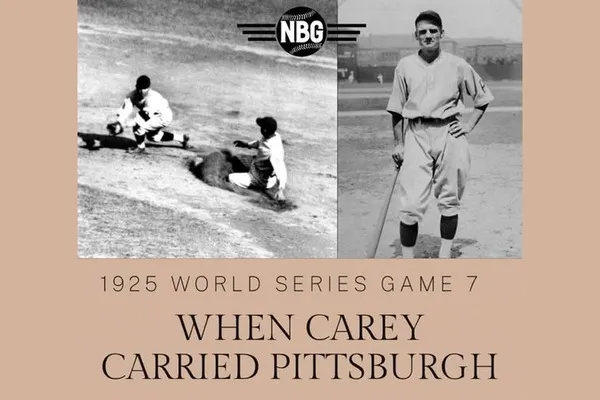
When Carey Carried Pittsburgh: 1925 World Series Game 7
Max Carey lingered in the dugout, anxiously awaiting the preeminent moment of his baseball career – Game 7 of the 1925 World Series. The game was delayed due to weather. Again. Commissioner Judge Kennesaw Landis called Game 7 the previous day because of torrential rains. They hadn’t let up.
The steady captain of the Pittsburgh Pirates was a member of the old guard. He started his NL career in 1910 – smack dab in the middle of the dead ball era. Carey had seen the game revolutionized, from one where runs were manufactured to the fascination with the long ball.
Carey became a successful player – he wasn’t born one. The only notable gift he possessed was his astounding speed. There was no otherworldly power like Ruth; Max only had 5 homers on the season and ended with 70 in his career. Max Carey slowly learned the game over time. Refining his craft, studying tendencies…anything to edge the opponent.
He had learned much from his mentor, Honus Wagner. When Carey joined the Pirates, he was braggadocios, proclaiming to the Hall-of-Fame legend, “I’m here to be the new shortstop.” Wagner, ever the professional, recognized the talent in the naive newcomer. Carey moved to the outfield where he became one of the greatest defenders of his era. Wagner played with the young star for 8 years before retiring at 43.
Honus taught Carey how to watch the pitcher’s delivery to get a respectable jump and to condition his legs for the long season.
The work paid off.
Max stole 738 bases in his career and led the National League an astounding ten times – the last of which was the 1925 season. Carey stole 31 bases in a row in 1922 and was rarely thrown out. An efficient, base stealing terror.
Honus worked with the speedy Max to get a better read on the ball in the outfield.
The work paid off.
Carey retired holding a major league record of six seasons with over 400 putouts. He led NL outfielders in range factor seven times and in assists four times. His 339 outfield assists are still the highest total for National League outfielders since the modern era began.
Now, as the puddles formed in the infield and sawdust was thrown down to absorb the moisture, Carey was the veteran leader. He would have to lead a crew of high potential but inexperienced ballplayers into battle. Pie Traynor, Glenn Wright, and Kiki Cuyler were outstanding - but all in their mid-20s. Max would have to show them, like Wagner before him, the right way to play the game.
Carey tried to maximize his talents as much as he could. The Pirates centerfield developed a keen eye and rarely struck out, going from 79 back in 1912 to 19 in the 1925 season. Max knew that if he put the ball in play – with his speed – he always had a chance. Continually looking to improve, Carey had watched Ty Cobb in spring training the previous season and developed a new stance to mimic the Detroit legend. It resulted in a 1925 season where Carey had a personal best .343 average.
The honing of his craft had led up to this moment – his first chance at a title. And a historic one! The Pirates were aiming to become the first team to overcome a 3-1 deficit in a best-of-seven series.
The rain continued to dump buckets onto the field. Visibility was poor as darkness shrouded Forbes Field. Gasoline was poured on the infield, and it was set ablaze to help dry things out. A common measure at the time, despite the high risk for an out-of-control fire, the method provided little relief from the swamp that enveloped the playing field.
As a determination for how to proceed was being discussed, Carey was thinking about some new information that had brought to his attention. The Pirates, whether today or (as it seemed increasingly likely) tomorrow, were going to have to face Walter Johnson. THE Walter Johnson. The same man who had won 2 previous games already in the series:
*In Game 1, Johnson struck out 10 in a complete game victory only allowing one run.
*In Game 4, Johnson only allowed 6 hits in a shutout.
Two games, both victories, all 18 innings. The climb ahead was foreboding, and Washington had a distinct advantage on the mound. But Carey had something he thought. And he needed everything he could get.
In talking with a fellow ball player, Detroit Tigers Bobby Veach, a flaw was disseminated to the information-savvy Carey: The Big Train had a big tell. Whenever Johnson shortened his delivery, it meant that he was going to throw a curveball. Walter’s fastball was especially devastating but Carey planned on sitting on the off-speed offerings, hoping that he would have a better chance of success.
As Carey visualized his plan, an announcement was made. To everyone’s surprise, Commissioner Landis determined that a game would be played in the chilly rain! Puddles and all. He didn’t want to disappoint fans again after already delaying the finale. Many of the paid attendance assumed cancellation. They were not AT Forbes Field. The stands were visibly empty to start the contest and many scrambled to make it to the game, missing the first inning entirely. Conditions were bad and they would continue to get worse.
Carey watched in disbelief from center as the visiting team put up four runs in the first inning. Starter Vic Aldridge could not get a grip on the wet ball. Three walks and multiple wild pitches plagued the normally reliable hurler. Tack on a catcher’s interference call and an infield error…things were going about as poorly for the Pirates as possible. Aldridge was replaced with Johnny Morrison.
Max was up second in the bottom of the first. After leadoff hitter Eddie Moore was retired after an attempted bunt against Walter, Carey massaged the at-bat to a full count. Max blasted a double to the home crowd’s delight. Walter Johnson doesn’t crumble so easily though. He struck out Kiki Cuyler on three pitches. Then he struck out cleanup hitter Clyde Barnhart on three as well. Carey was left stranded on second. The cool veteran righty dispatched the Pirates quickly once the heat turned up.
In the top of the second with one out, Goose Goslin lifted a short fly to center. The skies were so dark that reporters already were wondering when the game would be called. Carey, battling the visibility and soft ground, sprinted at full speed to make the difficult catch. Then in the third inning, with a runner in scoring position, Muddy Ruel crushed a ball to deep center. The field was a quagmire, and the outfielders weren’t visible from home plate. Every ball in play was a circus. With a steely focus, Carey managed to track down the deep drive and halt the threat.
The 35-year-old Carey’s opportunity arose again in the bottom of the third. The first two hitters touched up Walter. There was a runner on 2nd, and the Pirates had finally gotten a run across. To keep the rally going, Carey smoked the first pitch right up the middle to drive in the second run. After a groundout moved Carey to second, he caught Washington off-guard and stole third base without even a throw to contest it.
Grind away, one base at a time.
A blooper to right field brought Carey in to tighten the score and leave Pittsburgh down by one. The Pittsburgh fans were now into it! “They howled and screamed and forgot about the darkness and rain. They were cold and damp, but it was all forgotten in the raucous paeans of joy…” according to the New York Times.
But Washington responded with a 2-run double from Joe Harris in the fourth inning. The Pirates were down 6-3.
Max received another chance to hit in the fifth. As Carey approached the plate to lead off the inning, the Forbes Field faithful showered him with cheers in appreciation of his play thus far. Max responded with a leadoff double. Kiki Cuyler made it back-to-back doubles as the rain continued to fall. Johnson retired the next three batters to end the threat and complete five full innings – enough for it to be considered an official game.
As the inning was winding down, Commissioner Landis approached Washington owner Clark Griffith and offered his praise.
“Congratulations, you're World Champions. I'm calling this game at the end of the inning.”
Griffith did not accept the Commissioner’s offer. To his credit, he didn’t want a title that was tainted. He passed up Landis’ offer and the game played on…even as the rain fell harder and the skies grew darker.
"Once you started in the rain,” Griffith said. “You've got to finish it."
The game slugged on into the seventh inning stretch. Pittsburgh fans stood and remained standing for leadoff hitter Eddie Moore. Carey waited in the on-deck circle, as Moore lifted a 1-1 pitch to shortstop for what looked like a routine pop up. Washington’s Roger Peckinpaugh, with rain pelting his face, simply let the ball “slip through his fingers.” It was his seventh error of the series.
Pittsburgh fans kept standing, enthusiastically sensing a rally, as the crowd used umbrellas and newspapers to cover themselves from the downpour. Max walked into the batter’s box and attacked the first pitch – lining it towards left field. While Max sprinted towards first, everyone else squinted through the dark haze to see what was happening. Left fielder Goose Goslin drifted towards the line. The ball was close to the foul line, but nobody could quite tell what happened. Goslin dove but didn’t corral it. Washington claimed it was foul; the home plate umpire ruled it fair. (Even though there was probably no way he could have seen what happened.) Ultimately, it was ruled an RBI double.
With Pittsburgh now down by a run, Johnson stepped up to get the next two batters out. Carey bouncing off the bag at third represented the tying run as Pie Traynor came to bat. Traynor had three feeble attempts earlier in the game against Walter. This time would be different, as the ball cracked off the bat and disappeared into the mist. Carey scored easily.
As Max waited to see what happened, Traynor kept trucking around the bases. “The mud splashed from his spiked shoes as he rounded second and tore toward third.” Could Traynor come around for an inside the park homer? The ball suddenly appeared from the haze in the glove of 2B Bucky Harris as Traynor rounded third. Harris fired the ball home as Traynor’s feet managed to barely escape getting stuck in the sludge. He was out by such a large margin that a slide wasn’t even necessary.
Any temporary hope for the lead seemed as unlikely as a break from the pounding rain. In the top of the eighth inning, the goat of the previous inning, Roger Peckinpaugh, hit a solo shot to put Washington in the lead again. Some reports say he was carried into the dugout such was the ecstasy! Towels were used to wipe tears from faces…but also to wipe off bats. Carey watched hopelessly as the first two batters in the eighth were retired by the Big Train as rain dripped from his chin.
Reporter Damon Runyan wrote: "The outfielders were outlines, vague and shadowy. Twice Walter Johnson asked for a delay that he might get sawdust to scatter around the pitching mound. The base lines were channels of mud."
Max Carey hoped his teammates could muster as much fight as he had left. On a 0-2 count, catcher Earl Smith hit a double to right. In place of the pitcher, Pittsburgh sent up pinch-hitter Carson Bigbee – a .238 hitter. There were very few bullets left in the chamber for manager Bill McKechnie. Fans groaned, but they quickly turned to cheers, as the surprise hero knocked the ball into the outfield to tie the game. With Carey on deck, Johnson was struggling to find the plate. Washington fans were questioning whether Walter was tired and in need of relief. Leadoff hitter Eddie Moore walked, as a clearly spent Johnson was fighting through fatigue and weather conditions.
Carey strode to the plate, having gone 4-for-4 on the day against Johnson with three doubles. Max could break the tie. With conditions as they were, it was Walter throwing whatever gas he had left. Carey was hoping to make something happen. Put the ball in play. Just don’t strike out.
On a 1-1 pitch, Carey made contact, but the ball was shot directly to Peckinpaugh at short. What looked like a clear out. Carey sprinted like his life depended on it. Peckinpaugh grabbed the ball, and it slipped out of his hands. He picked it up off the ground and it slipped out again. With a throw to first out of the question, Peckinpaugh tossed the ball high to second base for the force out. Everyone was safe.
Standing on first, the game was still tied. Kiki Cuyler had to come through still. Carey saw Cuyler look helpless on a 1-2 pitch from Johnson. A surprise curveball that looked like strike three. Players were so sure it was a punchout that they were walking off the diamond. A gutsy pitch given the conditions at that moment. But ball two was called.
Cuyler wouldn’t miss his second chance.
On the next pitch he drove one into right field. Carey couldn’t see what happened. Nobody really could. Was it a grand slam? Carey just kept running around until he reached home. The ball landed fair, bounced foul, and then rolled into the bullpen underneath possibly a tarp. It was declared a ground-rule double and gave the Pirates a 9-7 lead, their first in the game.
Walter would get the next batter out, but Washington would go down in order in the ninth to secure the title for Pittsburgh. The crowd rushed onto the field and a spontaneous parade erupted in the streets. Fans mingled with players among the slop. “What kind of game just occurred?” Max Carey must have wondered.
According to the New York Times: “Water, mud, fog, mist, sawdust, fumbles, muffs, wild throws, wild pitches, one near fist fight, impossible rallies - these were mixed up to make the best and the worst game of baseball ever played in this country. Players wallowing ankle deep in mud, pitchers slipping as they delivered the ball to the plate, athletes skidding and sloshing, falling full length, dropping soaked baseballs - there you have part of the picture that was unveiled on Forbes Field this dripping afternoon.”
This would be the pinnacle of a Hall-of-Fame career for Max Carey. On the series, Carey hit a whopping .458 – his only postseason appearance. He had “been a sensation throughout the series, but he reached his greatest heights” during Game 7. “Directly or indirectly he was responsible for five of the Pirates’ nine runs.”
Carey played part of the next season in Pittsburgh before a dustup with management. He was released and spent time in Brooklyn, where he very quietly finished up his career. The Pirates, despite having a young core and a dazzling rookie premiering in 1926 by the name of Paul Waner, slumped to a third-place finish before rebounding the following season. After a 1927 World Series sweep to the Murderer’s Row Yankees, the Pirates would go another 33 years before capturing an NL crown.