Chase-ing the Truth: Baseball's Gambling Problem Before the Black Sox
There is water dripping from my ceiling. And nobody knows why! I’ll get back to that later…
Sometimes we get caught up in whether people lie or not. But the reality is, lying isn’t always about blatant falsehoods as much as withholding information or downplaying reality.
Take for instance the recently released documentary “You Can See Everything” about the Elizabeth Holmes scandal. One of my takeaways from that movie is that liars are so practiced that they don’t even view it as a lie. They use vague language; they use other people as scapegoats – anything to avoid admitting the truth and taking ownership. Sounds like a teenager I know.
Rewind to the Dead Ball Era. The infamous Black Sox Scandal of 1919 rocked the baseball world. Gasp! Players were scheming to throw the World Series! How could they? Because baseball folks had been massaging the truth for so long that many didn’t even see what the problem was. During that 1919 Series, Cubs secretary John Seys testified that he himself was holding bets for some of the gamblers. He said he thought nothing of it!
There are many instances of potential gambling. I have tried to focus on events where there is ample evidence to suggest it indeed happened. And in each instance, the events are brushed aside…there’s no problem here, nothing to see!
⚾️ 1912: Before Game 6 of the World Series, Red Sox ace Smoky Joe Wood advised his friends and family to bet on Boston before his scheduled start.
He was betting on himself. Where have I heard that before as an excuse? Anyway, Wood’s plans were thwarted as his manager bumped his start back prior to the game. The Red Sox lost, upsetting Wood and his posse. This was not seen as problematic by most! No punishments.
Later in his life, Ty Cobb wrote to Connie Mack: “Two times Boston and Washington wagered on their pitchers, Johnson and Wood, in a game. The papers were full of it. Pitchers who knew they would win more than they lost would wager on themselves for extra pocket money.”
It was also commonplace for players to “let up” against opponents in meaningless games.
Drip.
⚾️ 1917: Another one at Fenway Park!
I swear this isn’t all Red Sox bashing! In June of that year, a large contingent of gamblers congregated in the right-field bleachers. Many had wagered heavily on Boston. With substantial rainfall and the Red Sox losing, the gamblers came up with a scheme. They were to stop the game before it became official, allowing their bets to be refunded. Under the rules at the time, a game interrupted by rain before the completion of 4½ innings could be declared unofficial.
With two outs in the top of the fifth inning, around 300 spectators rushed onto the playing field from the bleachers. They weren’t initially trying to attack anybody. They simply stood around, deliberately delaying the game while hoping the rain would cause more problems. Snazzy plan.
Eventually chaos erupted. After a brawl occurred involving fans, players, and police – the game was resumed after 45 minutes of tomfoolery!
Gamblers taking matters into their own hands…this certainly is a bad sign. Give credit to Ban Johnson for going after some of the people involved. But, by all accounts, the gamblers in the bleachers were commonplace and little was done to evict these people from the ballpark. It was a known practice, and people just turned a blind eye.
Drip. Drip.
⚾️ 1917: The Tigers who were asked to “lay down” to help an opponent.
In September, the first-place White Sox were in a close race for the AL pennant when they met the Tigers in a crucial series. The White Sox won all four games against Detroit and ran wild on the basepaths stealing 22 bases.
After the series, each Chicago player contributed $45 to a pool for the Tigers pitchers, even players like Eddie Collins and Red Faber. The money was given to Detroit’s Bill James and distributed to the rest of the staff. White Sox officials knew about the pool but said nothing.
And if that isn’t foreshadowing, I don’t know what is. The White Sox squad, that two years later threw the World Series, is on board with paying off another team to throw games. Letting the opponent win in games that are determined as meaningless seems like a major problem.
Laying down…letting up…phrases used to soften the real problem that is happening. Games are being thrown.
Drip. Drip. Drip.
⚾️ 1918: Christy Mathewson accused Hal Chase of game-fixing.
Mathewson suspended Chase for offering bribes to both teammates and opponents.
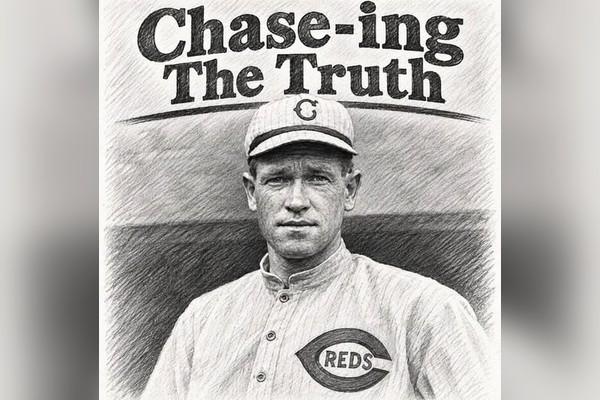
Ah…Prince Hal! You knew his name would pop up eventually. A man surrounded by rumblings of foul play. Two of his managers in New York, George Stallings and Frank Chance, accused him of “laying down” on their teams. Chase would miss signs frequently and dropped balls from his infielders in such a subtle way that it made their throws look like errors.
But this time he got caught by Mathewson and was punished! Unfortunately, the suspension was dropped in the off-season when Mathewson went to war and NL President John Heydler found insufficient evidence to sustain the charges.
The following season, in 1919, Chase gets traded to the Giants. He forms a two-man game-fixing ring with teammate Heinie Zimmerman. Chase and Zimmerman attempted to bribe three other Giants players to throw games. When Giants manager John McGraw found out, Zimmerman was suspended but not Chase.
Drip. Drip. Drip. Drip.
It should come as no surprise that those same White Sox, who had no punishment for paying off Detroit pitchers two years prior, and Hal Chase, who is still playing despite lots of evidence of his game throwing, join forces to cause the Black Sox Scandal. In testimony it was revealed that Chase won $40,000 in bets against the White Sox in that 1919 series.
What did you think was going to happen to baseball? People kept ignoring the imminent threats and just tsk-tsked a few people to make it seem like something was being done. Acting as if everything was fine.
“I’m not the crazy one, you’re the crazy one!”
That’s the line my teenage daughter just gave to me after I found the upstairs bathroom covered in water with multiple towels thrown in a hamper. Water dripping into the vent. Water soaking the upstairs carpet. Water dripping through the ceiling in multiple rooms.
When I asked her what was going on she said, “What are you talking about?!?”
“What am I talking about?!?! Look at the evidence, kid! You tried to cover up everything and act like there was no issue. Are you crazy? Do you think I don’t see the obvious signs of what is happening? The tub or the sink overflowed and now it’s causing major problems! Stop acting crazy and live in reality!”
People acting like gambling was not pervasive had their heads in the sand. Yes, look at the evidence! Any reasonable person knew what was happening and how MLB skirted the truth and tried to manipulate the issue. The gambling kept getting worse. Could this have been nipped in the bud a lot earlier?
Just like when Judge Kenesaw Landis started expelling players from baseball left and right after the Black Sox Scandal – I started taking car keys, the phone, devices, freedoms, etc. She’s going to pay for the ceiling paint and any other related problems that might occur down the road. Hope we don’t have any mold problems because that could cut into her Monster Energy drink funds!
Is it an overreaction? Not if you want to make a point and have people remember it.
Did Judge Landis overreact? Since MLB had years and years of tub overflows with minor consequences…I think you know my answer.